We are excited to have our garden featured on this week's Montana Fish, Wildlife and Parks' Outdoor Report. These brief videos are weekly news reports about Montana's great outdoors. This segment is a little different than most, since it is about backyard gardening, but we think Winston Greely did a great job making the connection between your landscape and nature. We thank him for putting together a great video introducing people to the concept of using native plants to create wildlife habitat in their own yards.
Wednesday, July 11, 2012
We are excited to have our garden featured on this week's Montana Fish, Wildlife and Parks' Outdoor Report. These brief videos are weekly news reports about Montana's great outdoors. This segment is a little different than most, since it is about backyard gardening, but we think Winston Greely did a great job making the connection between your landscape and nature. We thank him for putting together a great video introducing people to the concept of using native plants to create wildlife habitat in their own yards.
Tuesday, July 10, 2012
 |
| Indiscriminate cuckoo bumble bee (Bombus insularis) |
Last year I started an insect collection in order to document (and learn) all the insects visiting our garden. This project has been so much fun and such a rewarding endeavor. I am constantly amazed by the abundance and diversity of insects using our garden, and I am always fascinated by the ecological interactions going on in our little yard.
Last year I was obsessed with bee mimics- a variety of species, genera, and families that mimic bees and wasps. The ecology of these animals, and deception they employ, are really fascinating. This year, I am fascinated by bumble bees (Bombus species)- the gentle giants of Hymenoptera.
Last year I was obsessed with bee mimics- a variety of species, genera, and families that mimic bees and wasps. The ecology of these animals, and deception they employ, are really fascinating. This year, I am fascinated by bumble bees (Bombus species)- the gentle giants of Hymenoptera.
There has been a lot written about many pollinators, and even bumble bees in particular. Many species of bumble bees have declined for a variety of reasons- and many of them are the usual suspects- habitat loss, climate change, pesticides, etc… but another thing that intrigues me about bumblebees and their conservation is their nesting requirements. This relates directly to conventional landscaping. Bumblebees nest in the ground in underground burrows, so, more than anything, they need access to the ground: bare dirt they can burrow in to. This behavior puts them at odds with lawns, which cover most landscapes.
Bumble bees are not alone in being affected by lawns, indeed most of our native bees (over 75%) nest in the ground. However some species nest above ground in hollow cavities- holes formed by woodpecker drilling, from other insects boring into trees and even in hollow stems of plants like milkweed (Asclepias speciosa). These are the cavity nesting bees, like mason bees (Osmia species), that nest in bee boxes. For our other native bees (like bumble bees), bare ground is what they need. But unlike most of our native bees, which are solitary nesters, bumble bees are social and live in colonies.
Bumble bees are not alone in being affected by lawns, indeed most of our native bees (over 75%) nest in the ground. However some species nest above ground in hollow cavities- holes formed by woodpecker drilling, from other insects boring into trees and even in hollow stems of plants like milkweed (Asclepias speciosa). These are the cavity nesting bees, like mason bees (Osmia species), that nest in bee boxes. For our other native bees (like bumble bees), bare ground is what they need. But unlike most of our native bees, which are solitary nesters, bumble bees are social and live in colonies.
 |
| The original mason bee box |
So far I have collected and identified 12 species in our garden. Most of these are pretty common species, perhaps with the exception of the western bumble bee (B. occidentalis). Though locally common, the western bumble bee is in decline throughout its range and has even been locally extirpated, making it a species of concern throughout its range now. Historically they ranged from the Pacific coast east into Rockies and south to New Mexico.

Although several guides and resources are available, there is no one guide that is perfect for species found here in Montana. As a result, in order to identify bumble bee species I have been using a combination of guides including this key from Discover Life, a guide to Bumble Bees of the Western United States by the US Forest Service, a guide to bumble bees in North America by bumblebee.org and other online resources, like bugguide.net. Even with all these resources I still have some questions, and I still have a couple of specimens I have yet to satisfactorily identify. This is not to scare people off- it is a lot of fun learning about them and identifying them and many are actually quite easy to identify. One of my best references has become my own insect collection.
The interesting thing is all the diversity that is out there, and all the interesting behaviors and ecology. And all this can be found in your own backyard, provided you remove some lawn, plant some native plants, and take a look at what happens. So, last year, for me it was all about the mimics, and this year, bumble bees have my interest. Fortunately, there are hundreds of more species in my garden to keep my attention for years to come.
The interesting thing is all the diversity that is out there, and all the interesting behaviors and ecology. And all this can be found in your own backyard, provided you remove some lawn, plant some native plants, and take a look at what happens. So, last year, for me it was all about the mimics, and this year, bumble bees have my interest. Fortunately, there are hundreds of more species in my garden to keep my attention for years to come.
Thursday, July 5, 2012
 |
| Grand collomia (Collomia grandiflora) |
The garden is both nearing its peak of blooms and drying our from the hot weather that is normal for this time of year. As I've mentioned, we don't water anything in our garden- except our vegetables (we only water food), so as a result, the garden is ever changing and always seems appropriate and in-line with what is going on around us. That is, as the hills around Missoula dry up and turn a beautiful golden, so do parts of our garden, and it is nice. It feels and looks natural and appropriate for our climate and sense of place.
 |
| A sweat bee (Agopstemon sp.) gathers pollen from a three-veined fleabane (Erigeron subtrinervous) |
 |
| Blue harebell (Campanula rotundafolia) |
 |
| Blue elderberry (Sambucus cerulea) |
 |
| Fireweed (Chamerion angustifolium) |
 |
| The grand collomia and the back of the potting bench match |
 |
| Grand collomia and a fleabane |
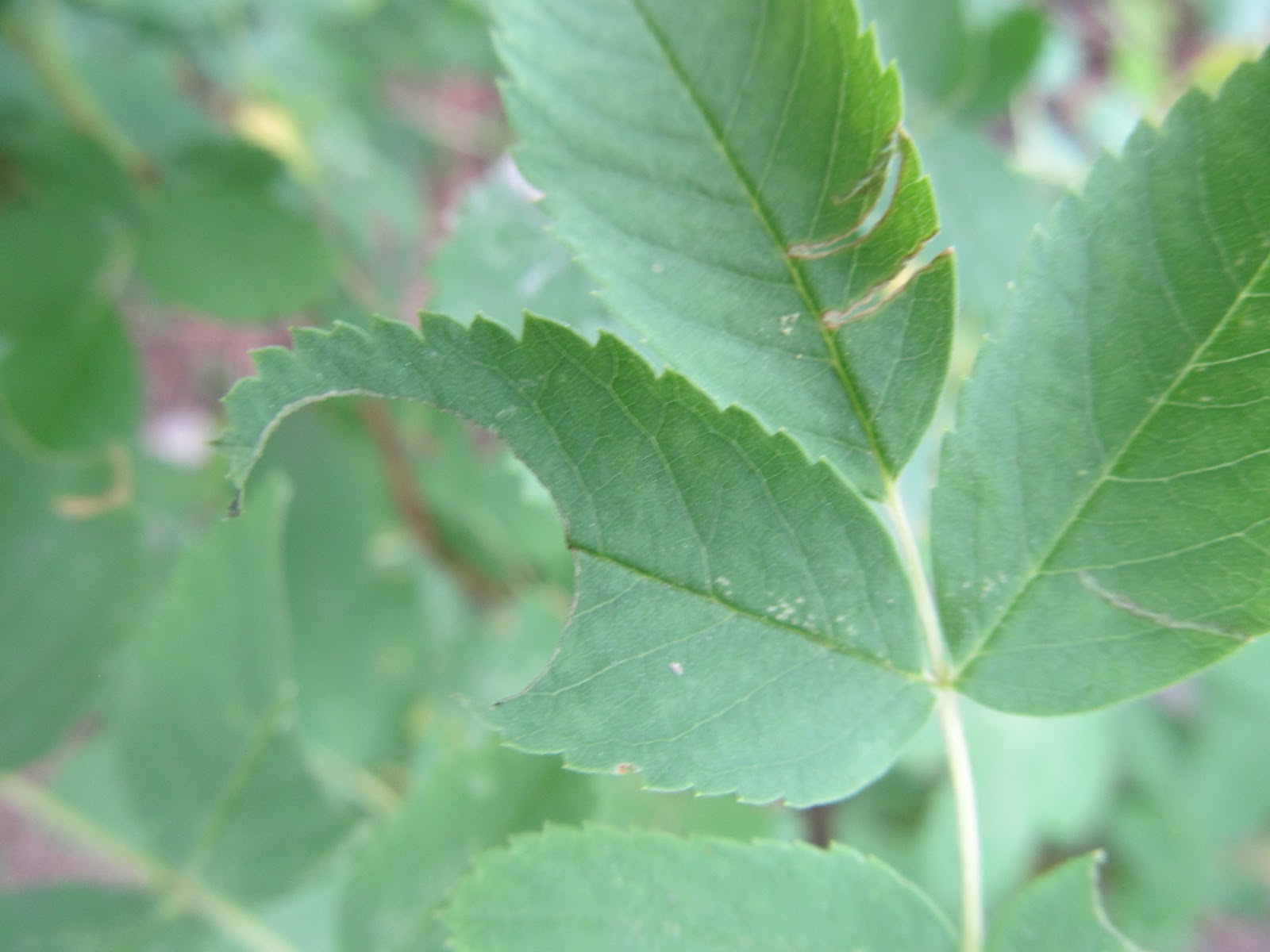 |
| Evidence of leaf cutter bees (Megachiladae)- they are stealing our Wood's rose (Rosa woodsii) |
 |
| Blue harebells, Erigeron and nodding onion |
 |
| Nodding onion (Allium cernuum) |
 |
| A sweat bee (Augochlora sp.) pollinates a fleabane. |
 |
| A mason bee (Osmia spp) in one of the waning Wilcox's penstemon (Penstemon wilcoxii) |
 |
| Happy 4th of July! A two tailed swallowtail enjoys a rest on a goldenrod in our garden (Photo credit: wife of Wildlife Gardener) |
Sunday, July 1, 2012

I crossed another project off my list a couple of weeks ago, by extending an urbanite path past our hammock and our tool shed out to the alley (on the left side int he photo above). Frankly, even though I had this on my list, I never really expected to do it this year.


The path out to the alley (and the tool shed) is much better defined and interesting now.

Our little cat Junebug (if you recall the reigning 2011 Cat of the Year) even helped. In her last days, I took her outside to enjoy some sun while I worked on this. Junebug, like all our cats, was an indoor-only cat, and when she'd go outside with me she would just sit by me and sleep. I think in her own way, she enjoyed being out in the sun participating in a garden project.

And speaking of garden projects, check out my friend Amber's blog- watch as she converts her lawn and yard into a native plant garden and beautiful vegetable garden.
So, to recap, here is my list of garden projects for 2012:
So, to recap, here is my list of garden projects for 2012:
- Make a three bin composter-
- Done- here is a link to more information about the composting station.

- Prune the white clematis on the arbor behind the shop
- Done!

- Install a nest box camera inside the nuthatch box.
- Done!
- Move the apple tree to the north east corner of the vegetable garden so its gets more light and water.
- Moving the apple tree will require relocating the rain barrel and path, then a little re-landscaping in the new and former location
- add a little fence or wall between the outdoor dining room and the hammock area

- Continue my insect collection
- Ongoing, and still enjoying the heck out if it.
- Connect the urbanite path in the back all the way to the alley.
- Done!
- Install power out to the greenhouse. This has been on my list for a few years, whether I write it down or not.
- Add some more shrubs to the front of the house- I've been working on this for a couple of years and I think it is starting to come together.
- Replace urbanite in front of the greenhouse and on the side yard that has settled too low. Replace it with larger chunks. It became painfully obvious last year that these low spots were too annoying to live with (it turns out, it was easier than I thought it would be to ignore this!)
- Build a fence in the front yard- I keep forgetting this. Kind of a big project, maybe I'll save it for the Spring 2013.
Yarrow (Achellia millefolium) and hairy false goldenaster (Heterotheca vilosa)are starting to bloom- I think of these as summer (or late summer) flowers.


Everyone enjoys a fleabane including this scarab beetle (Trichiotinus assimilis)- a bumble bee mimic.

For whatever reason our mountain hollyhockr (Iliamna rivularis) are blooming their heads off- it is quite a show, but I also wonder if this might be these plants last big hurrah.


Monday, June 25, 2012

Thanks to Liz Lodman from Montana Fish, Wildlife & Parks' Becoming an Outdoors Woman program (BOW) for organizing a great birding workshop and thanks for the invitation to participate. I always look forward to teaching workshops and programs at BOW events. It is great to see so many interested and engaged people of all different backgrounds learning about things that are important to me- whether it is hunting, fishing, or, in this case, birding in Montana. BOW is a great program and Liz does a wonderful job organizing all the events.
Below are links to posts on this blog that cover much of the information I discussed in the workshop:
- Mixed feelings for bird feeders
- Your yard as a feeder
- How to build a suet feeder
- How to make your own suet
- How to Build a Brush Pile
- Homeowners are Essential to Conservation
- Plant a Standing Snag for Wildlife
- Birdhouse basics
- How to clean and fill nest boxes
There are probably a lot more relevant posts, but that seems like plenty to get you started!
Here are a list of plants and other resources to get you going for growing your own backyard bird garden!
Easy to find, easy to grow, recommended native plants:
•Forbs
–White yarrow (Achillea millefolium)
–Horse mint (Monarda fistulosa)
–Hairy golden aster (Heterotheca villosa)
–Blanket flower (Gaillardia aristata)
–Blue flax (Linum lewisii)
–Wilcox’s Penstemon (Penstemon wilcoxii)
–Showy fleabane (Erigeron speciosus)
•Grasses
–Bluebunch wheatgrass (Agropyron spicatum)
–Prairie June grass (Koelaria cristata)
–Idaho fescue (Festuca idahoensis)
–Rough fescue (Festuca scabrella)
•Shrubby Shrubs
–Rubber rabbit brush (Crysothamnus nauseosa)
–Big Basin Sage (Artemesia tridentata)
–Woods Rose (Rosa woodsii)
–Golden current (Ribes aureum)
–Mock orange (Philadelphus lewisii)
•Shrubby Trees
–Red Osier Dogwood (Cornus stolonifera)
–Serviceberry (Amelanchier alnifolia)
–Chokecherry (Prunus virginiana)
–Mountain Ash (Sorbus scopulina)
–Quaking Aspen (Populus tremuloides)
–Elderberry (Sambucus cerulea)
–Black hawthorn (Creataegus douglasii)
Deer Resistant Plants:
•Bluebunch wheatgrass
•White Yarrow
•Blanket flower
•Hairy golden aster
•Monarda (bee balm)
•Penstemons
•Fleabanes
•Asters
•Goldenrod (Solidago spp)
•Showy milkweed (Asclepias speciosa)
Instant Prairie:
•Bluebunch wheatgrass
•Idaho fescue
•Prairie junegrass
•White Yarrow
•Blanket flower
•Hairy golden aster
•Monarda (bee balm)
•Sage/ rabbit brush
•Wilcox’s penstemon
•Showy fleabane
Books to help you get started (some of my favorites!):
•Bringing Nature Home
•The New American Landscape
•Shrink Your Lawn
•The Landscape Revolution: Garden with Mother Nature not Against Her
•Noah’s Garden
•Paradise by Design
•The Forgotten Pollinators
•Landscaping with Jays
•Gardening with a Wild Heart
•The Magic of Montana Native Plants
Saturday, June 23, 2012
My wife spent the afternoon re-potting some of our basil (read: a huge fleet of basil) in our shady area repurposed potting bench. Although this new addition to our garden performs many tasks (room divider, buffet, potting bench and trellis), today was the first day it got a workout as a potting bench.
Here are just a few photos showing her (and the potting bench) in action.

We grow a lot of basil. Everything from Genovese basil (pictured) to Siam queen and holy green.

These plants will go back into our greenhouse where they will fulfill their destiny. We don't grow basil outside of our greenhouse anymore- the production in our greenhouse is so much greater. A few years ago, we compared yield of basil grown outside vs inside the greenhouse. With the greenhouse basils, we were able to harvest leaves from each plant 3 times before our outside basil was ready to harvest for a first time.
So, after an afternoon using the potting bench, I am happy to report that, according to my wife, the potting bench is "functional".
Wednesday, June 20, 2012

Celebrate National Pollinator Week by joining me at the Fort Missoula Native Plant Garden this Thursday (June 21) at 5:30 pm to learn about bee and wasp mimics. This workshop is presented by the Montana Natural History Center. I hope to see you there.
I will discuss insect identification in general (i.e., the distinguishing characteristics of bees, flies, beetles, moths, etc...), and introduce the diversity of native bees in Montana and their interesting ecology. And then the exciting part: exploring the Great Deception by flies, moths, and others who mimic the color and shapes of stinging insects!
There is a suggested $5 donation to the Montana Natural History Center, which helps support natural history education for all ages.
There is a suggested $5 donation to the Montana Natural History Center, which helps support natural history education for all ages.
Subscribe to:
Posts (Atom)


